
Visualization and the Brain: How Mental Rehearsal Works

If you’ve ever pictured a future performance going perfectly, you’ve already used mental rehearsal. This simple technique harnesses your brain’s predictive machinery to improve skills, calm nerves, and accelerate learning. In this guide, you’ll learn what mental rehearsal is, why it works, and how to build a fast, reliable routine you can use daily.

What Is Mental Rehearsal?
Mental rehearsal is the deliberate practice of running through a skill, event, or habit in your mind as if it were happening now. You simulate the sights, sounds, movements, and emotions of success. Done correctly, it primes the same neural networks you use during real performance, making action feel more familiar and automatic when it counts.
Why Mental Rehearsal Works
Your brain is a prediction engine. When you imagine a scenario vividly, regions involved in attention, movement, and emotion light up in patterns similar to real execution. This “as-if” activation lays down or strengthens neural pathways, improving timing, coordination, confidence, and recall. It also reduces cognitive load: because your brain has “seen” the event, fewer resources are spent on uncertainty and fear. In short, mental rehearsal shifts you from threat to opportunity, from doubt to readiness.
The Mental Rehearsal Protocol (5 Steps)
- Define the target
Specify a single outcome: “Deliver a confident five-minute intro,” “Land a clean tennis serve,” or “Start coding without procrastination.” - Prime your state
Sit upright, breathe slowly, relax your jaw and shoulders. A calm, alert state increases imagery vividness and retention. - Run a vivid script
See what you would see, hear what you would hear, and feel what you would feel. Include environment, timing, and the first action you’ll take. Keep sequences short (30–90 seconds). - Correct and replay
If the image slips or a mistake appears, pause, reset, and replay the improved version. End each run with a success snapshot and a brief hit of gratitude. - Bridge to action
Finish with a concrete trigger: “When I open my laptop at 9:00, I start the outline immediately.” This links rehearsal to real behavior.
Mental Rehearsal for Skill Building
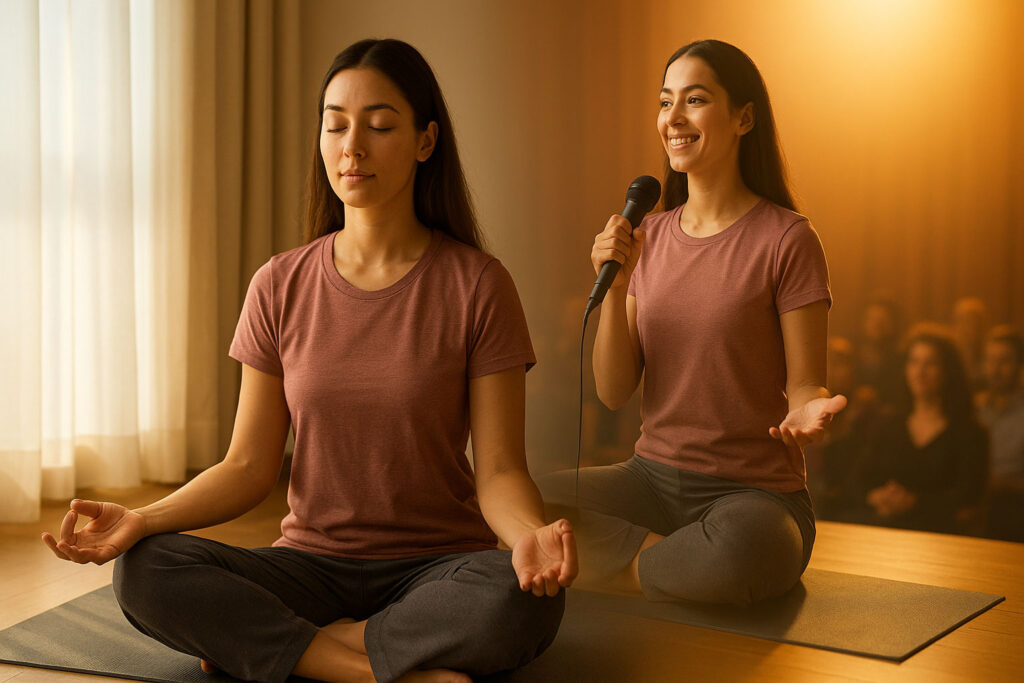
Whether you’re preparing a presentation, learning an instrument, or improving sport mechanics, mental rehearsal closes the gap between knowing and doing.
- Public speaking: Visualize walking on stage, planting your feet, breathing, delivering your first sentence clearly, and making friendly eye contact.
- Sports: Rehearse footwork, body alignment, and follow-through. Keep the imagined tempo realistic.
- Music: Run the passage at performance tempo in your mind, focusing on fingerings and phrasing.
- Coding/design: Picture opening the project, naming the first branch or file, and completing the first small unit of work to overcome inertia.

Mental Rehearsal for Habit Change
Habits are cue-response loops. Use imagery to pre-experience the cue and your ideal response.
- Implementation intentions: “If it’s 6:30 a.m., then I put on shoes and step outside.”
- Cravings and distractions: Picture the urge appearing, then see yourself labeling it, breathing, and returning to your task.
- Evening wind-down: Imagine closing devices, dimming lights, and entering a relaxed pre-sleep routine.
Pairing Rehearsal with Real Practice
Mental practice doesn’t replace doing; it multiplies it. A practical split is 20% mental rehearsal, 80% physical practice. Use imagery to warm up, refine form between reps, and consolidate lessons after a session. When you can’t practice physically (travel, injury, limited time), rehearsals preserve gains and keep timing sharp.
A 7-Minute Daily Routine
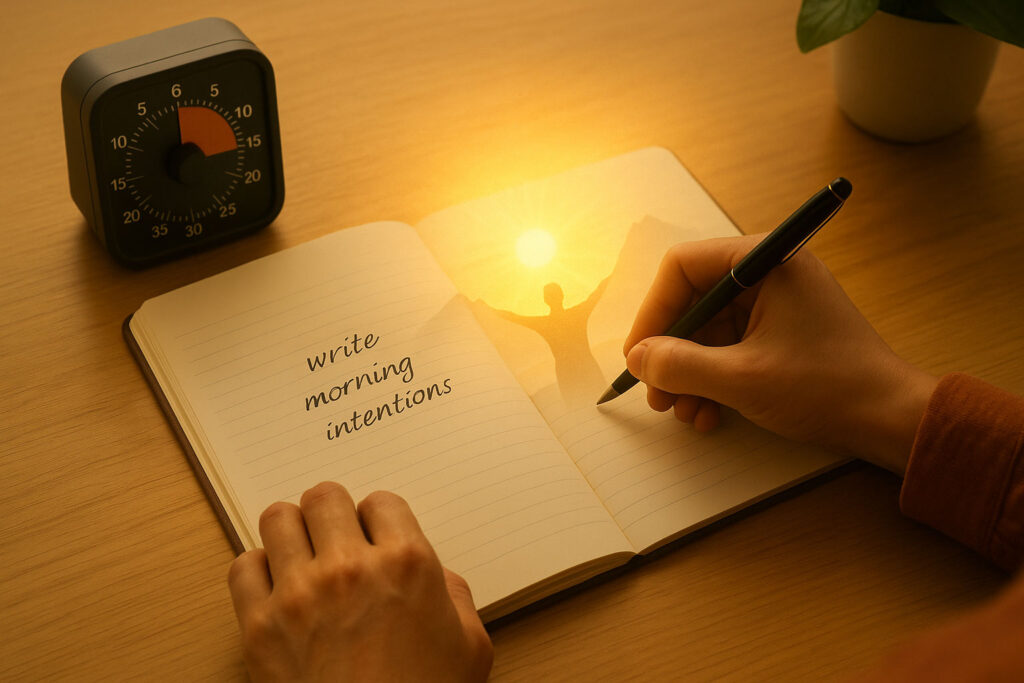
- Minute 1: Breathe slowly and relax (inhale 4, exhale 6).
- Minute 2: State the exact outcome for today.
- Minutes 3–4: Run the success script twice (30–60 seconds each).
- Minute 5: Run a “challenge script” where a common obstacle appears and you respond skillfully.
- Minute 6: Bridge to action with a clear trigger and the first 60 seconds of real behavior.
- Minute 7: Seal with gratitude and an energizing posture.
Mental Rehearsal for Confidence and Anxiety
Nerves come from uncertainty. Rehearsal reduces uncertainty by pre-experiencing success. Add two tools:
- Somatic anchor: Pair your final success snapshot with a grounding cue (press thumb to forefinger, or exhale slowly). Use the same cue on stage or in competition.
- Time travel: Rehearse the moment after you finish—calm, proud, relieved. Your brain starts aiming for that state.
Make Images Stick: Sensory and Emotional Detail
- Visual: Colors, lighting, positions, and micro-movements.
- Auditory: Your tone of voice, ball-impact sound, audience hush, or typing rhythm.
- Kinesthetic: Muscle tension, balance, breath, and contact points (feet on floor, fingers on keys).
- Emotional: Calm focus, curiosity, joy, or competitive edge. Label the feeling: “This is what prepared confidence feels like.”
Common Mistakes in Mental Rehearsal
- Vague scenes: Without detail, the brain doesn’t know what to encode.
- Watching yourself from far away: Prefer first-person perspective for skills; third-person is fine for posture and presence.
- Replaying failure: Acknowledge mistakes briefly, then quickly correct and replay success.
- Too long, too soon: Five crisp run-throughs beat a fuzzy fifteen-minute slog.
- No bridge to action: Always end with the first physical step.
Tracking and Progress
Keep a tiny log: date, target, number of runs, and one improvement you felt. Note results after the real event. Patterns emerge quickly: smoother starts, reduced hesitation, better timing, and more realistic pacing.
Advanced Strategies
- Chunking: Rehearse difficult sections in isolation, then stitch them together.
- Tempo shifts: Imagine slow motion to refine technique, then normal speed.
- Environment randomization: Change imagined venues, lighting, and mild distractions so you’re ready for anything.
- Social rehearsal: Picture supportive faces or one friendly ally in the room.
- Recovery scripts: Visualize handling a slip with composure and humor; this removes fear of imperfection.
A Quick Starter Template
- Outcome: one sentence.
- Context: where, when, who’s present.
- Cues: what starts the action.
- Steps: 3–5 moments you will execute.
- Challenge: one likely obstacle and your response.
- Success snapshot: the finish line and the emotion you want to feel.
- Bridge: the first small action you’ll take in the next hour.
Final Thoughts
You don’t need special talent to benefit from mental rehearsal. You need clarity, consistent short sessions, and the willingness to bridge imagination to action. Use the protocol above for one meaningful outcome this week. As the wins stack up, expand to skills, habits, and confidence under pressure—the brain learns what you teach it, especially when you teach it twice: first in the mind, then in the world.